
AI-generated images are illustrative reconstructions and may not always accurately reflect historical reality. The narrated text, however, has been checked against historical sources.
This article goes deeper into the episode’s topics and brings together sources for further reading.
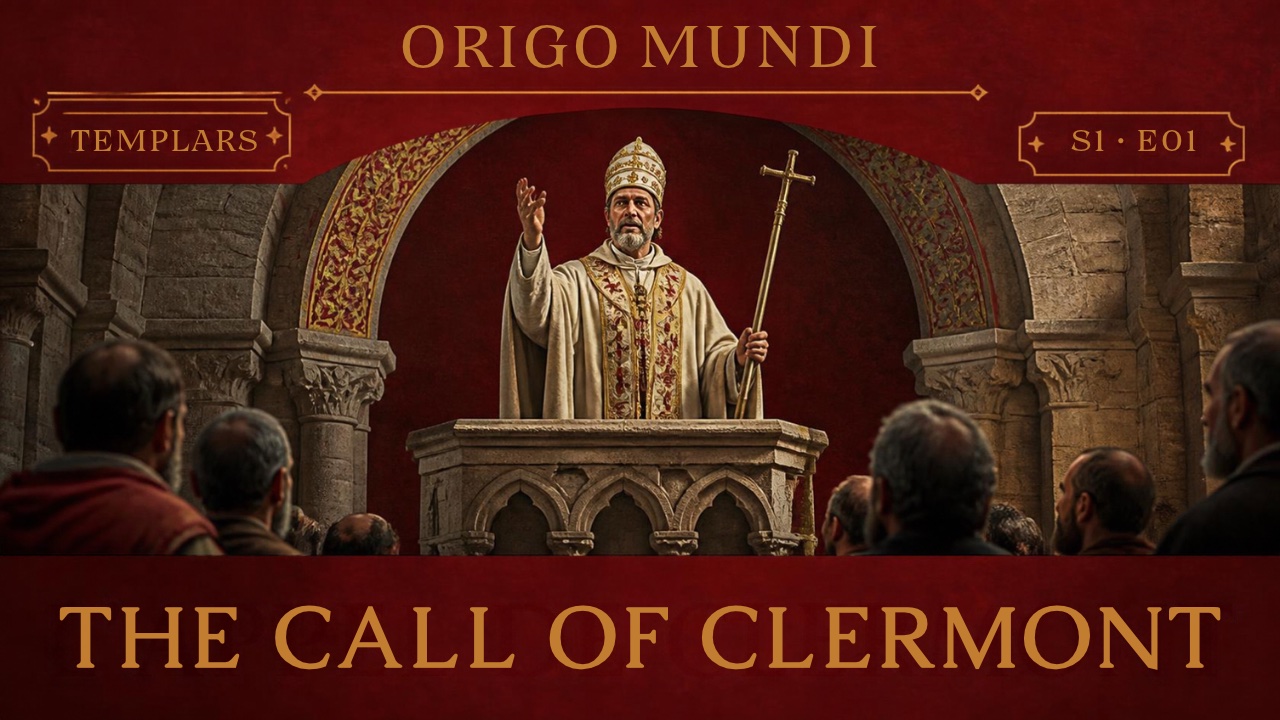
A council before it was a call
Clermont was first of all a church council. At the time, popes gathered bishops and abbots to settle Church discipline, peace among Christians and the authority of Rome. The Council of Clermont met in November 1095 and lasted several days, in the Auvergne, then part of the Duchy of Aquitaine. Urban II, born in Champagne, had been a monk and then prior of Cluny, the great centre of monastic reform.
The decisions reported are not only about the East. The council renewed the Truce of God (a pause in fighting at certain times of the week and year), upheld the excommunication of King Philip I of France over his remarriage to Bertrade de Montfort and, according to Fulcher of Chartres, reminded the clergy to avoid simony. A caution: the link between the Truce of God and the expedition comes mainly from Fulcher, writing after the events. No reliable figure survives for how many people attended.
The Eastern Roman Empire at the end of the 11th century
In the East, the Eastern Roman Empire faced pressure from the Seljuk Turks in Anatolia. The turning point was the battle of Manzikert on 26 August 1071: the imperial army was defeated by Alp Arslan and Emperor Romanos IV was captured. Chroniclers such as Michael Attaleiates and John Skylitzes (11th century) and Matthew of Edessa (12th century, writing in Armenian) record it, from different viewpoints. Civil wars followed and control of Anatolia was contested, but there was no instant collapse. In 1081 Alexios I Komnenos took power. Twenty-four years separate Manzikert from Clermont: the battle matters, but it is not the sole, direct cause of the crusade.
A word on vocabulary. In this series we say “Eastern Roman Empire” and “Eastern Romans”. “Byzantine” is a label historians adopted later; it is not what contemporaries called this state, whose capital was Constantinople.
The request at Piacenza
At the Council of Piacenza (1–7 March 1095), a major moment of papal reform in a time of schism, an embassy of Emperor Alexios asked for help, according to Bernold of Constance. That help was requested is attested; what the request covered, and how Urban II turned it into a far broader appeal, remains debated: Latin documentation is brief and Greek sources do not simply confirm a request for a Western expedition.
Three places, three stakes
Clermont is the place of the call; Constantinople is the capital of a power seeking military help; Jerusalem carries particular religious significance: for Christians it is tied to Christ’s death and resurrection and to the Holy Sepulchre, a destination for pilgrims long before the crusades; it also matters to Jews and Muslims. Helping an empire and taking a holy city are not exactly the same goal. The map in the video uses these three names as geographic reference points. It is schematic: it is neither an 11th-century document nor a single route followed by every group; routes and aims differed.
The speech: versions written later
On 27 November 1095 — the date tradition gives for the public call — Urban II delivered the speech associated with Clermont. We have no exact record of his words: the surviving versions were written later by several authors (Fulcher of Chartres, Robert the Monk, Guibert of Nogent and others), with different emphases — aid to Eastern Christians in one, Jerusalem and the Holy Sepulchre in another.
The witnesses, and how far from the event
Gesta Francorum (anonymous) c. 1100–1101; Fulcher c. 1100–1105; Baldric of Dol c. 1105; Robert c. 1107; Guibert c. 1107–1108 — roughly five to fourteen years after the event. Fulcher is generally presented as present at the council; for Robert, historians hesitate. A recent analysis suggests Fulcher addresses mainly the clergy, Robert and Guibert more military listeners, Baldric a mix. Guibert himself says he reports the spirit of the speech rather than its exact words. Georg Strack finds Fulcher’s version closest to 11th-century papal preaching: that gives it weight, but it is not a recording.
“Deus vult”
The formula “Deus vult”, “God wills it”, is often associated with Clermont. It appears in accounts written after the event and became a rallying cry in the tradition of the First Crusade. We cannot say the whole assembly shouted it in that form.
The word “crusade” did not exist in 1095
Contemporaries speak of a journey, an expedition, a pilgrimage. In Robert the Monk’s account the pope presents the undertaking as a sacred pilgrimage, and those who set out are first called pilgrims. “Crusaders” comes later (Latin “crucesignati”, those marked with the cross). According to the chroniclers, those who committed themselves wore the cross on their clothes. The armed journey remained a pilgrimage — with a vow, penance, and weapons. “First Crusade” is a modern term.
The spiritual reward: choosing words carefully
The sources mention a spiritual reward. We say “remission of penalties or sins according to the sources”, not “plenary indulgence”, a later theological notion. Three kinds of documents are involved: Urban II’s letter of December 1095, the later accounts of the speech, and a surviving canon of the council (canon 2), whose wording and translation are debated; it presents the journey as aimed at freeing the Church of Jerusalem. The council also had a wider reform agenda.
Why leave? What the journey cost
There is no single answer: penance and devotion, prestige, land, a collective adventure, a wish to channel the violence of private wars. Families, servants and pilgrims also set out. But wanting to go was not enough: weapons, protection, horses and provisions had to be paid for. Some sold property or pledged land; Duke Robert of Normandy pledged his duchy to his brother, the king of England. That tempers the picture of men who all left to get rich easily.
The December 1095 letter, a leader, a preaching tour
The letter, in the edition consulted, is addressed to the faithful then waiting in Flanders and mentions protections for those taking part. It sets a rendezvous: to set out for the feast of the Assumption, 15 August 1096. It names a leader, Adhémar of Monteil, bishop of Le Puy, from a noble family of the Valentinois and a supporter of Church reform; a pilgrimage of his own to Jerusalem in the mid-1080s is uncertain. Urban II appointed him legate: a spiritual leader, while the armies remained divided among several chiefs. Adhémar died at Antioch in 1098.
Urban II did not leave France right after Clermont but kept preaching: attested at Limoges (around Christmas 1095), Le Mans (February 1096), Nîmes (July 1096), Gap (18 August) and Asti in Italy (9 September 1096). The sources do not reconstruct his whole itinerary.
1096: departures, not a single army
The first groups set out in 1096, of different sizes, at different times and by different routes. Clermont does not by itself create all the causes of the crusade, but it gives a common shape to religious, political and social concerns already present. The Templars do not yet exist; their story, however, cannot be understood without this dynamic.
Chronology
- 26 Aug 1071 Manzikert
- 1081 Alexios I
- 1–7 Mar 1095 Piacenza
- Nov 1095 Clermont (27 Nov by tradition)
- Dec 1095 letter, Limoges
- Feb 1096 Le Mans
- Jul 1096 Nîmes
- 15 Aug 1096 rendezvous
- 18 Aug Gap
- 9 Sep Asti
- 1098 death of Adhémar.
- Around 1100–1108: accounts of the speech are written.
What we do not know
Urban II’s exact words; how many attended; the exact scope of the Piacenza request; the wording of canon 2; the precise protections in the letter.